

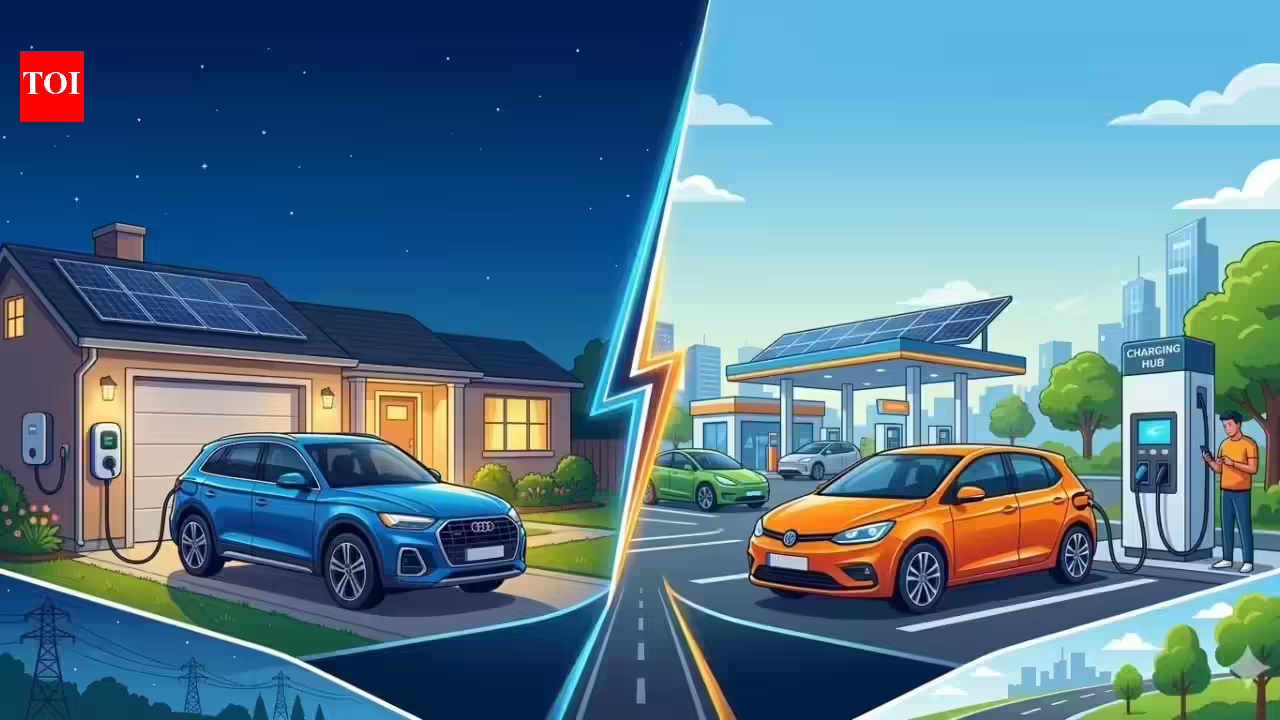
Electric vehicles are becoming increasingly common on Indian roads, but one question still confuses many buyers: how do you actually charge an EV? Unlike petrol or diesel cars that depend on fuel stations, EVs can be charged at home, at workplaces or at public charging stations. Here’s a quick guide on home vs public charging.
How does EV charging work?
EV chargers are broadly classified into AC chargers (slow or normal) and DC fast chargers. AC chargers typically provide between 3.3 kW and 22 kW of power, while DC fast chargers can range from 30 kW to 240 kW. The difference in power directly affects charging times: AC charging can take several hours, while DC fast charging can fill most batteries much faster.
Types of EV Chargers used in India
India currently uses multiple charging standards to support different types of vehicles. AC chargers are the most common type and are commonly installed in homes, offices, and residential complexes. These include the Type-2 AC charger, which is widely used by electric cars, and the Bharat AC-001 charger primarily used for two- and three-wheelers. Power output typically ranges between 3.3 kW and 22 kW.DC fast chargers are designed for quick charging and are commonly found at public charging stations or on highways. These include standards like CCS2, which is currently the dominant fast-charging system for electric cars in India. High-power DC chargers can deliver between 50 kilowatts and 350 kilowatts of power, allowing many EV batteries to charge from 10 to 80 percent in about 20-60 minutes, depending on size and vehicle compatibility.
Home charging: the most common option
For most EV owners in India, home charging is the primary method of charging. In fact, many automakers recommend slow charging at home as the best daily charging solution.When you buy an EV, the manufacturer usually provides a home charging unit or wall box charger. These chargers are installed in the parking area and connected to the home power supply. Some EVs can also charge via a standard 15-amp plug socket, although a dedicated wall charger is usually faster and safer.The biggest advantage of home charging is convenience. Owners simply plug in the vehicle overnight and start over the next day with a full battery. Charging at home is also usually cheaper as electricity rates for homes are lower than business rates.
Public charging: useful for traveling and quick top-ups
Public charging stations are designed for situations where drivers need a quick recharge. These stations are usually located at shopping malls, office parking areas, petrol pumps, highways and dedicated EV charging hubs. However, public charging often costs more than charging at home. Charging rates depend on the operator and type of charger, but fast charging usually carries a premium due to higher equipment and electricity costs.On the other hand, public chargers are helpful for long-distance travel or emergency top-ups, especially on highways where fast charging can quickly increase range.As EV adoption increases and more chargers are installed across the country, the gap between electric and conventional fueling facilities is expected to narrow significantly over the next few years.
(TagstoTranslate)Electric vehicle charging(T)Home charging vs public charging(T)Types of EV chargers in India(T)Benefits of home charging(T)Public charging stations(T)DC fast chargers(T)AC chargers(T)Charging time for EVs(T)India AC-001(T)CCS2
