

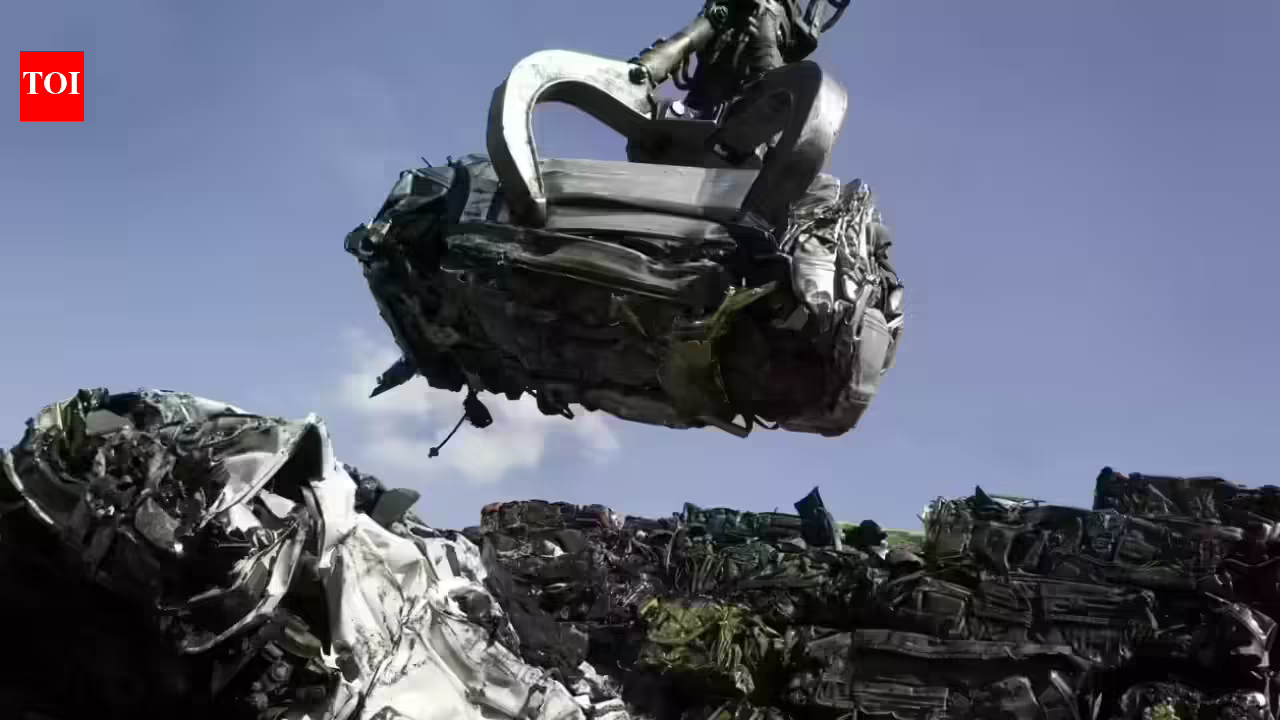
This article is written by Karthik V Nagpal. President, Rosmerta Technologies.The vehicle scrappage policy is an important turning point in India’s journey towards a circular economy. Phasing out old and unfit vehicles, improving roads with new and safer vehicles and reducing pollutants caused by old engines is yielding huge gains in domestic supply of secondary raw materials including steel, aluminum and plastics, while also improving road safety. However, the transition from a well-intentioned policy to ground-level industrial reality is proving to be a bumpy road. The main challenge has shifted from policy formulation to system delivery, and this is where our main focus should now be.The national intention is clear, but the pace of the implementation process is being dictated by a harsh reality: gaps in infrastructure and regional disparities. How we overcome these obstacles will determine our success in modernizing the ecosystem.
infrastructure gap
The structure of the policy rests on two key components which are Automated Testing Stations (ATS) to identify scientifically unfit vehicles and Registered Vehicle Scrapping Facilities (RVSF) to dispose of them in an environmentally safe manner. Although progress is clear, as the number of RVSFs is set to exceed 129 facilities by the beginning of 2026, the magnitude of the task remains intense. According to the NITI Aayog report, India will require about 441 ATS in 2027 compared to 156 today and 227 RVSF against the sanctioned 178. With over 88% of end-of-life vehicles (ELVs) entering the informal sector, formal facilities are performing at sub-optimal capacity, and cannot compete with the business efficiency of informal dismantlers and in many cases lack of regulatory compliance.
issues of regional inequality
The extreme imbalance of regions is perhaps the most significant challenge. By the end of 2025, only 16 states will have ATS, of which Gujarat alone has one-third. Other states, and especially eastern and north-eastern India, have little or no formal screening or testing infrastructure. This creates an uneven circular map where progressive states like Gujarat, Maharashtra and Haryana are growing, while the rest are lagging behind. A vehicle cannot be termed scientifically unfit without a local ATS, nor can it actually be scrapped without a local RVSF. Thus, the coverage of the policy remains limited.Global standards can be followed to reduce the gap between regional disparities in the Indian scrappage scenario, global standards provide concrete blueprints of fair scaling up. For example, the reuse model in Japan involves original equipment manufacturers (OEMs) in end-of-life management by automobile recycling legislation, and the reuse of ELVs is 99%. Such incentives can be adapted by requiring OEM-supported networks of collection and directing informal flows into formal reuse programs in low-coverage eastern and north-eastern states in India.
Lost signal between testing and scraping
Even in places where ATS are available, they are not yet effective triggers of scrapes. According to recent data, most of the vehicles tested receive ‘Fit’ certification, and conversion to ELV status remains negligible. This suggests that the ATS is currently functioning more as a compliance certification channel rather than an attestation mechanism. The system does not have the required push factor which is important to divert unfit vehicles in the test lane to the scrapping bay. As a result, RVSFs run out of feedstock, their businesses are compromised, and formal circular chains are disrupted at an earlier stage.
The way forward: a recipe for modernization
First, there must be policy alignment and supercharging of incentives. The new SASCI 2025-26 scheme, with graded compensation and bonuses to states in case of scrapping of government and private vehicles, and setting up of ATS, is a powerful step forward. States need to aggressively utilize these funds and emulate successful models such as the privately owned ATS model in Gujarat, which has proven not only in speed to scale but also in commercial feasibility. Further, to develop a uniform pan-India consumer incentive, there is a need to standardize the best practice of Certificate of Deposit (COD) concessions across all states, as suggested.Second, the great equalizer is technology and digital integration. Any contemporary scrap ecology needs to be information-based. Since Aadhaar-linked ownership transfer is proposed to be implemented in the VAHAN portal, it can remove the presence of ghost owners and can be done only in case of end of life vehicles which will be successfully de-registered through COD submission. Advanced platforms like V-Scrap can democratize information for scrap price discovery, ensuring transparency and fair pricing for the end vehicle owner. Third, we must design the economics of recycling. Formal players need alternative sources of revenue to compete with the informal sector. This implies the formalization of the spare parts market, which is currently one of the largest sources of informal earnings. Also, there is a need to strengthen the extended producer responsibility (EPR) system of ELVs and have higher levels of recovery targets to pull real demand towards materials supplied by formal recyclers, which will make them economically viable. Finally, the informal sector should not be isolated but integrated. The informal network that exists is very large and intelligent in doing business. This can be transitioned to the formal world with a phased process, providing one-time compliance waiver, availability of finance on the Enterprise Assist platform and technical training, making these small operators potential participants or collection agents of the RVSF. In fact, the vehicle scrappage ecosystem in India is at a critical crossroads. The policy intent is strong and the basic infrastructure is being created. However, success will not be dictated or defined by blanket orders, but by our strength in tackling challenges at the grassroots level. We can create a circular automotive economy by combining state-level action with central policy, using technology to help achieve transparency, and engineering an ecosystem where formal recycling is both environmentally healthy and economically beneficial. It is a planned process of not only scrapping old vehicles but also systematically recovering and maintaining their value for a more sustainable and mobile India.Disclaimer: The views and opinions expressed in this article are solely those of the original author and do not represent the Times Group or any of its employees.
(TagstoTranslate)Udyam Assist Platform(T)Registered Vehicle Scrapping Facilities(T)OEM(T)Vehicle(T)NITI Aayog(T)Vehicle Scrappage Policy
