

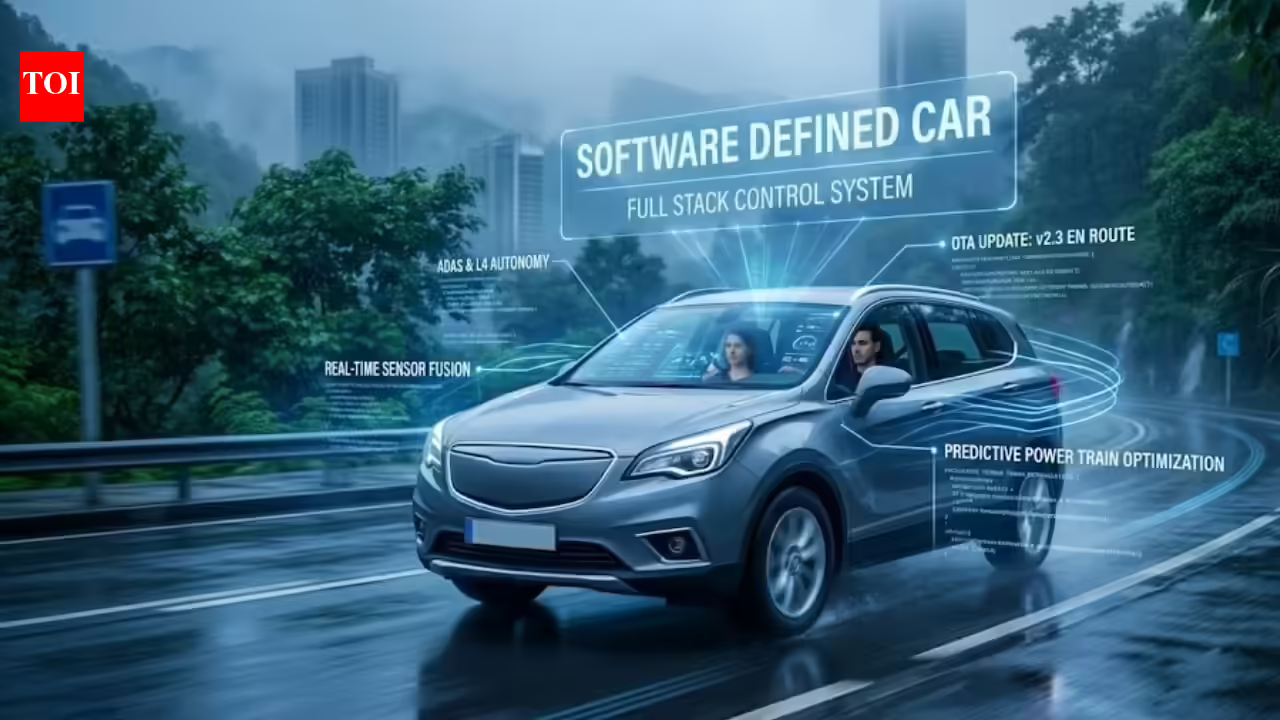
Who has written this article? Prashant Doreswamy- CEO and President Aumovio India.The automotive sector is going through one of the most significant transformations ever. For decades, vehicle innovation was limited to mechanical engineering. Today, software and electronics are becoming equally important determinants of vehicle capability, performance and customer experience. The modern vehicle is evolving into a sophisticated computing platform where intelligence is embedded in every function.Software-defined vehicles (SDVs) are at the center of this transformation. It is often described as a smartphone on wheels, which downplays its complexity. A smartphone is expected to perform all essential functions through a processor, primary operating system, and a limited set of sensors. For example, an automobile system now has more than 100 microcontrollers, hundreds of sensors, multiple displays, and multiple operating systems (AUTOSAR, Linux, QNX). One of the biggest engineering problems in the industry is to make it operate smoothly while achieving safety and reliability requirements.
Cars are becoming software platforms
Traditional vehicle architectures were built around dozens of electronic control units (ECUs), each responsible for specific functions such as powertrain management, braking, infotainment or safety systems. As new features were added over time, the number of controllers increased, creating greater complexities in system integration, wiring, and software management. Managing communications between these distributed systems became a significant engineering challenge. To address this, the industry is transitioning toward centralized computing architectures powered by high-performance computers (HPC) and zone control units. Instead of distributing intelligence across many different controllers, these architectures consolidate computing resources into a small number of powerful processing units. This approach simplifies system design, improves scalability, and provides a strong foundation for future software innovation. More importantly, it enables vehicles to evolve throughout their lifecycle rather than remaining static at the point of manufacture.
Reshaping the software ownership experience
One of the distinguishing features of a software-defined vehicle is the separation of software and hardware. Historically, vehicle functionality was strongly related to the physical components added during manufacturing. Adding additional capabilities sometimes requires purchasing new hardware or waiting for the next generation vehicle. Software can now be written, modified and deployed autonomously, helping manufacturers continually improve vehicle performance and usability.This change has changed the ownership experience. Over-the-air upgrades allow you to add new features, improve existing capabilities, increase efficiency, and resolve problems without contacting a service center. The vehicle effectively becomes a living, evolving platform. This provides manufacturers the opportunity to develop digital services, subscription-based features and personalized products that generate value far beyond the initial car purchase. The interaction between car manufacturer and consumer is becoming more continuous than transactional.
digital cockpit and Connected Vehicle Ecosystem
Smartphones and connected devices have really changed the game in cars. People now expect their cars to work just as smoothly as their phones – think smooth screens, easy-to-use controls, personalized settings and quick updates. Because of this, the cockpit is no longer just a bunch of dials and buttons; It’s becoming a complete digital hub that puts the driver right at the center.Modern automobiles now form a coherent ecosystem that includes digital instrument clusters, head-up displays, large-format touchscreens, voice interface systems, and cloud-connected services. These technologies provide drivers a common interface to access navigation, entertainment, car diagnostics and customized preferences. Connected platforms enhance the experience by enabling remote car operation, software upgrades and data-driven services. The automobile is becoming an extension of the larger digital lifestyle, offering experiences beyond the actual drive.
Building Trust in a Software-Defined Age
As automobiles become more networked and software-centric, cybersecurity has emerged as a top issue. Modern automobiles interface with cloud platforms, mobile apps, charging networks, and external infrastructure, resulting in new channels that must be protected from potential threats. Securing automotive systems today requires a holistic strategy that includes hardware security, secure software development, encrypted communications, access controls, and ongoing monitoring.This change is also affecting the way cars are manufactured and verified. Traditional testing approaches are no longer sufficient to handle the complexities of software-driven systems. Virtual development environments and simulation platforms allow engineers to create, test, and validate software behavior long before actual prototypes are built. These digital development methods enable us to accelerate innovation while keeping in mind the high quality and safety requirements required in the automobile sector.The automobile industry is moving toward a new era in which software and electronics will serve as the foundation of vehicle innovation. From centralized computing and connected services to sophisticated safety systems, electrification and cybersecurity, the vehicle’s digital capabilities are becoming increasingly important. Automobiles of the future will still rely on excellent mechanical engineering, but their intelligence, flexibility, and value will be determined by the software and electronics that run them. As this transformation progresses, it will become more impossible to distinguish between a car and a computing platform.Disclaimer: The views and opinions expressed in this article are solely those of the original author and do not represent the Times Group or any of its employees.
(TagstoTranslate)Software-defined vehicles(T)Vehicle cybersecurity(T)Automotive electronics(T)Vehicle ownership experience(T)Over-the-air upgrades(T)Automotive innovation(T)Centralized computing architecture(T)Connected vehicle ecosystem(T)Automotive engineering
