

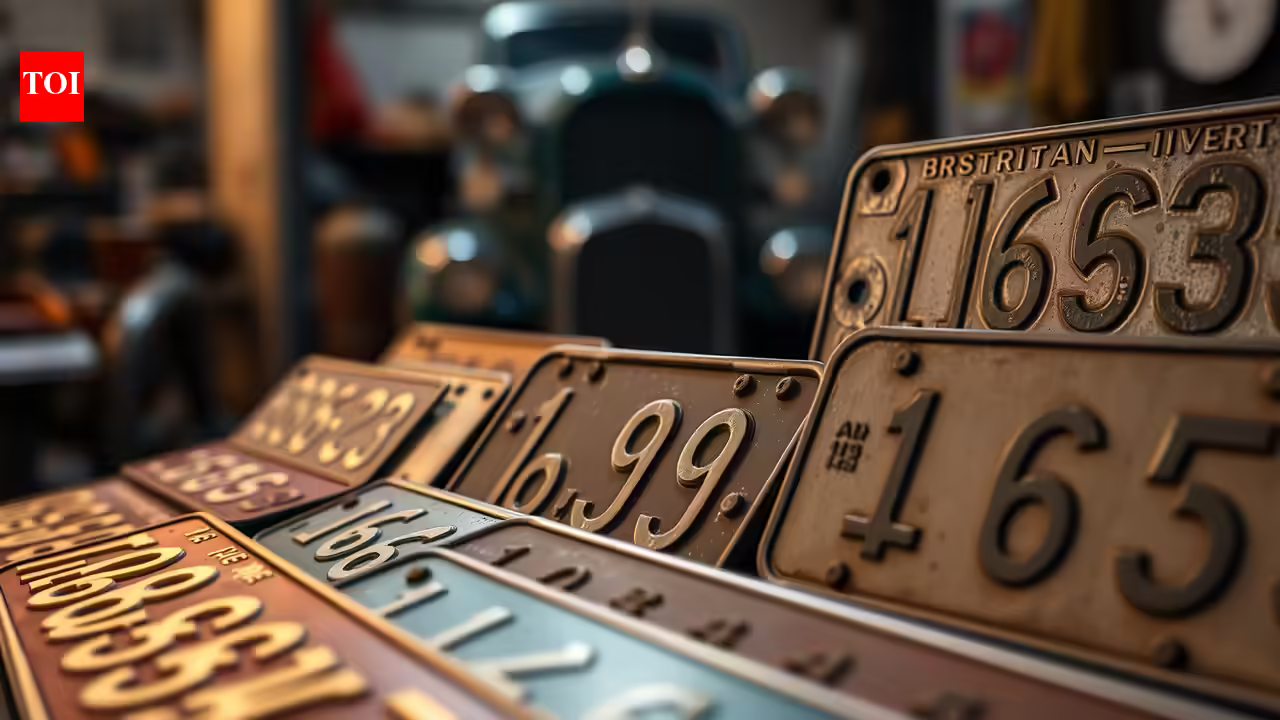
Whenever a traffic camera catches a speeding vehicle or a hit-and-run witness writes down the registration number, it relies on a system that is more than 130 years old, invented not because of GPS or digital databases, but because early automobiles were creating chaos on roads still dominated by horse-drawn carriages, and no one could figure out who was responsible. The vehicle number plate, that small rectangular slab of metal or aluminum affixed to the front and rear of every car, truck, bus and bike on the road, has a history stretching from 19th-century Paris to two world wars, prison factories and India’s own colonial-era registration chaos. It is one of the oldest continuously used systems of public identification in the world, and has outlived almost every other technology of its era.
The surprising reason why number plates are mandatory!
The automobile appeared in the 1880s and almost immediately created public order problems. These fast, furious, unpredictable machines shared the roads with horses, pedestrians, and cyclists, and when accidents occurred, there was no reliable way to identify who was driving or whose vehicle it was. Unlike a horse, which can often be traced back to its owner, a car can easily be traced. The criminals also noticed this.As early as 1749, a Paris police officer recommended to King Louis XV that a vehicle registration system be established in the capital to more effectively track criminals. That proposal went nowhere for more than a century. But by 1893, with the number of motor vehicles increasing on French roads, the situation demanded action. On August 14, 1893, the Paris Police Ordinance was passed, making France the first country in the world to introduce mandatory vehicle registration. The ordinance requires that every motor vehicle must display a metal plate in legible writing showing the name and address of its owner along with a unique number. The plate had to be placed on the left side of the vehicle and could never be hidden. The basic logic was simple: If a vehicle is involved in an accident, crime or dispute, there needs to be a way to get it to a person.
Diffusion of number plates in Germany, the Netherlands and throughout Europe
The French system was not limited to Paris for long. In 1896, Germany adopted its own vehicle registration rules. Two years later, in 1898, the Netherlands became the first country to implement a truly national number plate system, which applied uniformly throughout the country rather than city by city. The Dutch called it a “driving permit” and their first plates bore only the number 1. By August 1899, that count had reached 168 registered vehicles. By 1906, when the Netherlands redesigned its system, the number had surpassed 2,000, showing how quickly the automobile was taking hold.The United Kingdom joined in 1904, when the Motor Car Act 1903 came into force and required all motor vehicles to be listed on an official register and display number plates. Politicians of the time already understood that the car was going to transform economies, and they pushed for systematic regulation ahead of time. By the first decade of the 20th century, most of Western Europe had adopted some version of the number plate. France itself extended the system from the Seine department to the entire country, and by 1901 all French vehicles were required to carry registration plates, no matter where they were driven.
The US joins in and asks car owners to make their own plates
Number plates in the United States arrived a little later and with much greater improvement. On April 25, 1901, New York Governor Benjamin Odell Jr. signed a law requiring motor vehicle owners to register their cars with the state and display their initials in letters at least three inches high on the rear of the vehicle. There were no government issued plates. Car owners were simply expected to craft their own identification tags, from whatever material they chose: leather, wood, rubber, iron, or even cardboard. Some painted their initials directly on the vehicle. Others attached handmade tags. The system was functional in concept but extremely inconsistent in practice.Massachusetts cleared it in June 1903, and became the first US state to issue government-made number plates made of iron with porcelain enamel, with white numbers on a dark blue background. The first plate with the number 1 went to Frederick Tudor. By 1918, nearly all 48 contiguous states had followed Massachusetts in issuing formal plates. During World War II, when steel was sent for military production, some states briefly issued plates made of cardboard or pressed soybean fiber, which sometimes led to the problem of farm animals eating vehicle registration plates, which is as absurd as it sounds. Steel became the standard material around 1912, and has remained the baseline since then, with aluminum becoming increasingly common in subsequent decades.
History of India’s number plates from the colonial patchwork to the Motor Vehicles Act
India’s vehicle registration history reflects the complexity of its colonial era. Before 1939 there was no nationwide system. Different regions and princely states used whatever format they preferred, with the princely states having their own completely different registration schemes, often displaying a number after the state name, such as Mysore 1 or Jodhpur 5. The one-letter, four-number format was used from 1914 to 1939 in areas of British India.The Motor Vehicles Act of 1939 was the first attempt at a unified national registration framework, although the princely states that had not yet acceded to India continued with their own formats until independence and unification. After 1947, as the map of India stabilized, vehicles in the newly integrated areas were re-registered under the new format. For decades after independence, each district or regional transport office used its own three-letter code, which created significant confusion as a plate starting with MMC could belong to any location across the country.real standardization came with Motor Vehicles Act 1988 and its 1989 revision, which introduced the two-letter state code system that Indians are familiar with today, DL for Delhi, MH for Maharashtra, KA for Karnataka, and so on, with a two-digit RTO district number and a unique alphanumeric sequence. This format came into force on 1 July 1989 and ultimately provided the country with a legible, consistent and traceable registration system.
High-security plates, digital registration and number plates in the 21st century
The evolution of number plates did not stop with standardization. As the number of vehicles increased globally, new threats emerged: plate cloning, counterfeiting, and the use of fake plates to avoid traffic fines or commit crimes. The response was the High Security Registration Plate (HSRP), which India made mandatory for all new vehicles from April 1, 2019 and later for all old vehicles as well. from india hsrp system It features a chromium-based hologram, laser-etched serial numbers, a snap-lock system that makes the plate no longer reusable once removed, and a link to a centralized digital database, essentially turning a piece of aluminum into a tamper-proof identification document.Internationally, several US states, including Arizona, California, Michigan and Texas, have introduced digital number plates, small flat-panel screens that can be updated remotely and display real-time registration status. Connecticut had already introduced the concept of personalized vanity plates in 1937, allowing car owners to choose their own characters, a trend that spread globally in the second half of the 20th century.What began as a simple metal tag bearing the owner’s name and address in the 1893 Paris Ordinance has grown into a sophisticated, globally standardized identification system that integrates with speed cameras, toll systems, criminal databases and satellite tracking infrastructure. The number plate designed to command film cameras, telegram offices and horse-drawn carriages shows no sign of disappearing. If anything, it’s getting smarter. A small rectangle of metal, first strapped to a carriage-era automobile in Paris, has quietly become one of the most enduring administrative inventions in history. It still works, still scales, and is still becoming more sophisticated, a reminder that even the simplest solutions to the right problem don’t need to change.
(tagstotranslate)paris
